
- Details
- Written by: Ricardo Matosinhos
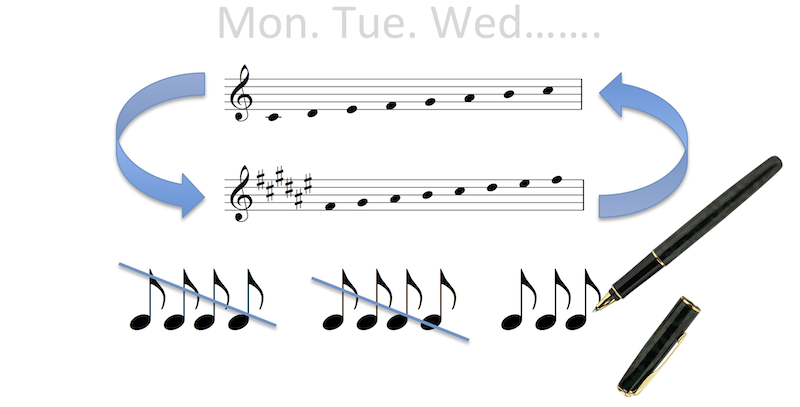
The very basis of tonal music consists of Major, minor scales and arpeggios. According to the music instrument different learning sequences can be used. However they all tend to culminate in all major and minor scales. At that point a rotating Scale Review Scheme can be a great help in the learning process.
On one hand working each scale in detail has its benefits since it allows you to meticulously work each aspect, but it gives you only a narrow point of view from one single scale. You just lose sight of the big picture! On the other hand working in review mode gives us a wider but not so detailed view. So how do we come out of this situation?
I strongly believe that both approaches are needed and that they actually complemented each other. That’s the reason why I developed the following rotation scale review scheme in 12 days.
In the left column appear the major and minor scales, following a circle of 5ths to be played in detail: major and relative minor scale, different articulations, arpeggios with and without inversions, chromatic scale etc.
In the right column one specific aspect is selected to be worked out in every scale.
My advice is to start slowly and to increase, every 12 days, the difficulty level by conditioning tempo, articulations, rhythm and the number of octaves.
The Major and minor scales are just the beginning as there are many other scales, arpeggios and modes. So I recommend this scheme to be adapted in order to meet each student’s specific needs.
Click here to download the Scheme as PDF
- Details
- Written by: Ricardo Matosinhos
Well, what is the origin of the horn standard fingerings after all?
Watch this video to find it out and to understand how a horn actually work.
English captions available. Press the button below the video.
- Details
- Written by: Ricardo Matosinhos
The notes we play on the horn, come from the overtone series, that's to say the notes we can play with the same fingerings, changing the shape of the lips only. In order to understand an overtone series, there's nothing better than a graphic explanation, step by step...
- Details
- Written by: Ricardo Matosinhos
In the western music there are several systems to represent the note names. I'm presenting in this video a small explanation, flowed by a small introduction to transposition for horn beginners.
- Details
- Written by: Ricardo Matosinhos
The holidays are a over, now it is time to practice!